The History of Icebreaking
A journey through centuries of engineering, from the first wooden hulls reinforced with iron bands to the high-tech marvels of the modern era.
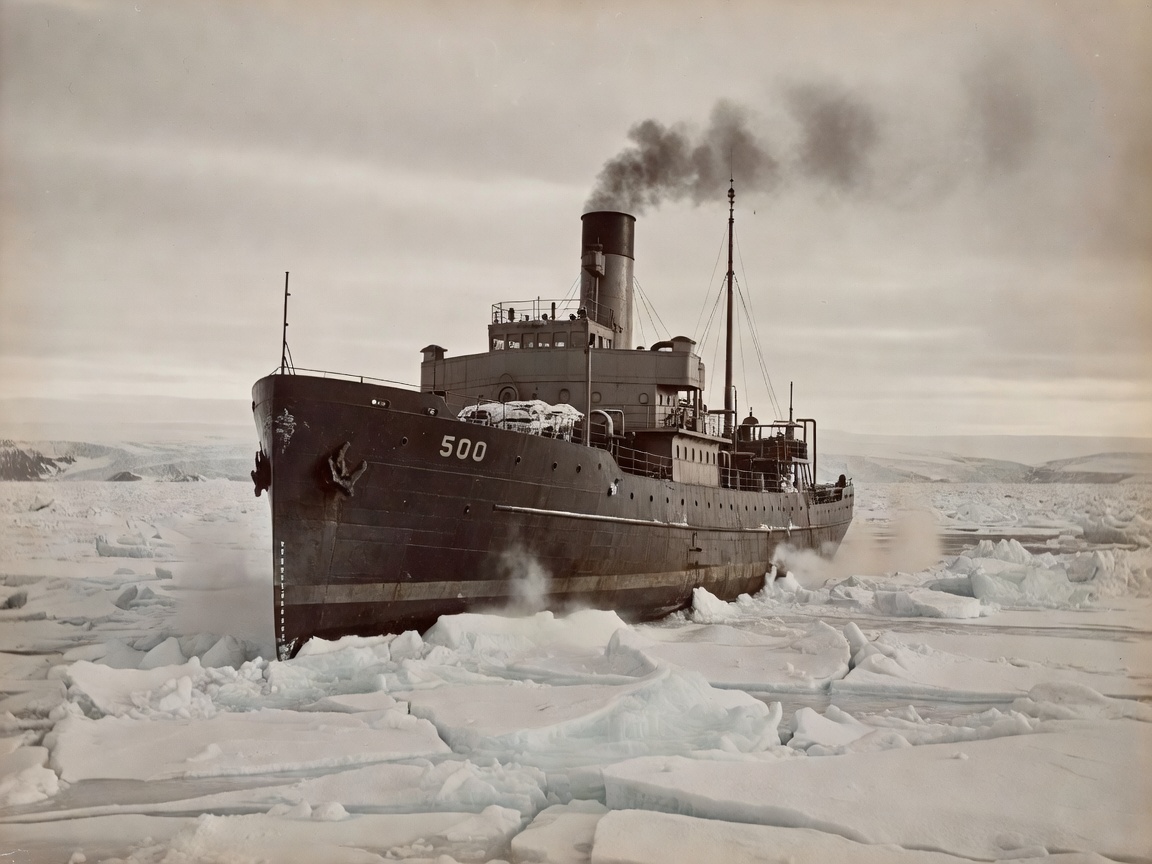
Early Attempts and the Pilot
The human need to navigate frozen waterways is not new. Early attempts to break ice involved manual labor—sailors leaning over the bows of wooden ships with long saws and axes, attempting to carve a channel. The true evolution of the icebreaker began in the mid-19th century. In 1864, a Russian merchant named Mikhail Britnev modified a small steamboat named the Pilot. By altering the bow to slope upwards, the vessel could ride onto the ice and crush it under its own weight. This fundamental design principle remains the core mechanic of icebreaking to this day.
The Era of Steam and Steel
As industrialization took hold, steel hulls replaced wood, and powerful steam engines provided the brute force necessary for larger vessels. The most famous early example was the Yermak, launched in 1899. Designed by Russian Admiral Stepan Makarov and built in England, the Yermak was the first true polar icebreaker. It featured a heavily reinforced steel hull, an aft-sloping bow, and multiple steam engines. It proved highly successful, operating for over six decades and demonstrating that continuous polar navigation was achievable.
Design Milestones
- The Spoon Bow: Moving away from the sharp "V" shape of traditional ships to a rounded, spoon-like bow that optimized the crushing effect over ice.
- Diesel-Electric Propulsion: Introduced in the mid-20th century, these systems allowed engines to run at optimal continuous speeds to generate electricity, which then drove electric motors connected to the propellers. This prevented engine stalling when a propeller struck heavy ice.
- Heeling Tanks: Internal ballast systems that rapidly pump water from one side of the ship to the other, creating a rocking motion to free the hull if it becomes trapped in converging ice flows.
The Nuclear Age and the Northwest Passage
The post-WWII era brought the atomic age to polar exploration. The Soviet Union launched the Lenin in 1957, the world’s first nuclear-powered surface ship and icebreaker. It shattered previous endurance records, operating for months without fuel constraints. In the West, the 1969 voyage of the SS Manhattan, a massive oil tanker fitted with an icebreaking bow, proved that commercial transit of the Northwest Passage was possible, sparking intense geopolitical interest in Arctic shipping routes.
Modern Innovations: Double-Acting Ships
Today, icebreaker technology has entered a new paradigm with the invention of azimuth thrusters (Azipods). These are electrically driven propellers housed in steerable pods beneath the hull, capable of rotating 360 degrees. This led to the concept of the "Double-Acting Ship."
A double-acting ship is designed with a traditional bulbous bow for efficient, low-drag cruising in open water. However, its stern is shaped like an icebreaker bow. When the vessel encounters thick ice, it physically turns around and sails backwards. The milling action of the Azipod propellers pulls water and broken ice away from the hull, significantly decreasing friction and allowing the ship to break thicker ice going astern than it ever could going forward. This dual-optimization represents the pinnacle of current icebreaking history.