Ice Classification Standards
Decoding the complex global framework that dictates exactly what kind of ice a vessel is legally and physically permitted to break.
The Necessity of Standardization
Not all ice is created equal. A sheet of newly formed "first-year" ice is fundamentally different in hardness and density than "multi-year" ice that has survived several summer melts, expelling its brine to become as hard as rock. Consequently, ships must be rated according to the specific ice conditions they are structurally capable of withstanding. The unified system utilized globally today is dictated by the International Association of Classification Societies (IACS).
The IACS Polar Classes (PC)
The IACS established seven Polar Classes, ranging from PC1 (the highest capability) to PC7 (the lowest). A vessel's class determines not only the thickness of its hull plating but the density of its internal framing, the power of its propulsion systems, and the materials used for its propellers.
| Class | Operational Capability Description |
|---|---|
| PC1 | Year-round operation in all polar waters. Capable of handling thick, multi-year ice. Only the world's most powerful nuclear icebreakers achieve this. |
| PC2 | Year-round operation in moderate multi-year ice conditions. Usually high-end heavy icebreakers. |
| PC3 | Year-round operation in second-year ice which may include multi-year ice inclusions. |
| PC4 | Year-round operation in thick first-year ice, which may include old ice inclusions. |
| PC5 | Year-round operation in medium first-year ice. Common for high-end expedition cruise ships. |
| PC6 | Summer/autumn operation in medium first-year ice. The standard for most modern polar tourism vessels. |
| PC7 | Summer/autumn operation in thin first-year ice. Often applied to Baltic Sea ferries and light cargo. |
Ice-Strengthened vs. True Icebreaker
A crucial distinction in maritime classification is the difference between an "ice-strengthened" ship and an "icebreaker." An ice-strengthened ship (often PC6 or PC7) is designed to push through broken ice floes left in the wake of an icebreaker, or to navigate thin, newly formed ice. Its bow is usually standard-shaped but built with thicker steel.
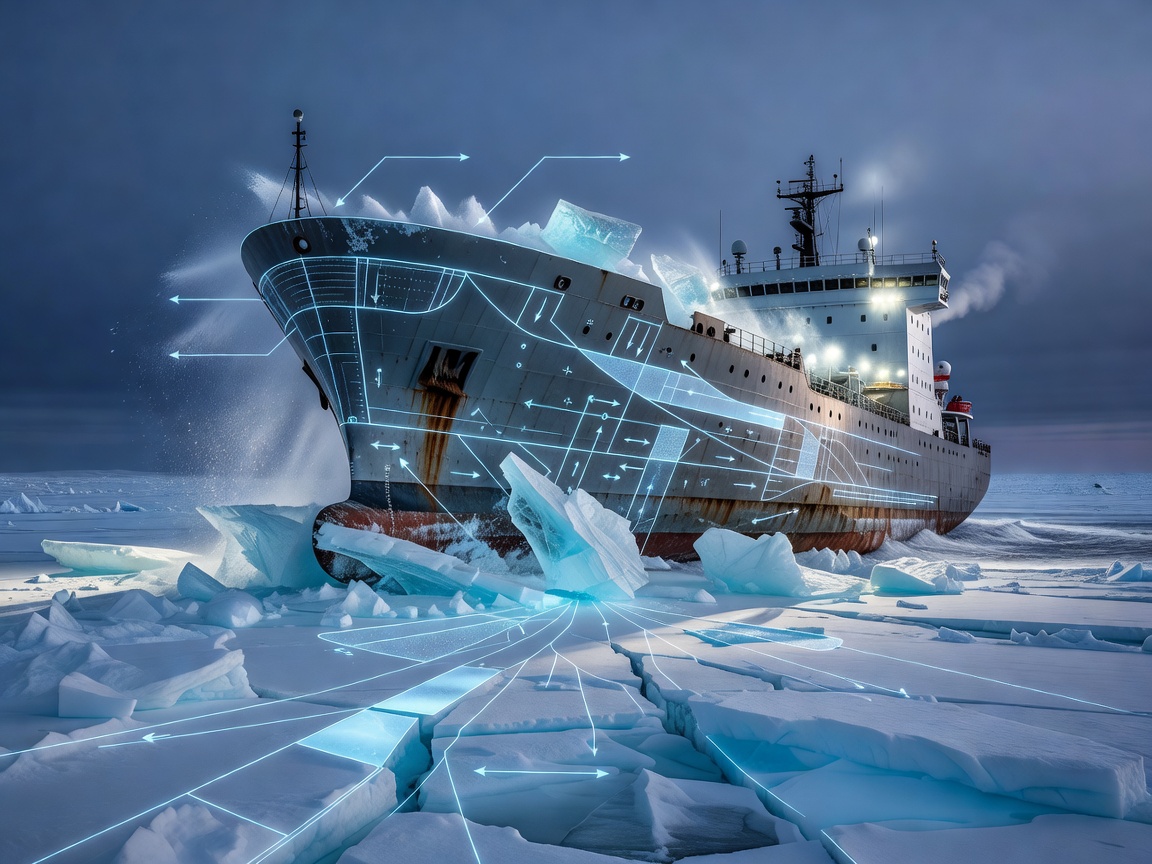
A true icebreaker (usually PC1 to PC4) is designed to independently break solid, unbroken ice sheets. To achieve this, it relies on a specialized bow shape (such as the spoon bow). The ship does not simply plow through the ice; it drives its sloping bow up onto the ice sheet, allowing the immense weight of the vessel to crush the ice downwards. This requires a specific center of gravity, tremendous propulsion power, and an "ice belt"—a significantly thickened ring of steel wrapping around the entire waterline of the hull.
Regulatory Compliance
Classification is not merely a badge of honor; it is a strict legal requirement. The IMO Polar Code mandates that ships operating in defined Arctic and Antarctic waters must hold a valid Polar Ship Certificate. Insurers will void coverage immediately if a captain takes a PC6 vessel into PC3-rated ice conditions. The classification dictates the ship's safe operating limits, ensuring that the crew, passengers, and the fragile environment remain protected from maritime disaster.